
The erosion of trust in institutions isn’t a sudden collapse, but a slow bleed of connection, and for climate science, that gap is widening faster than policy can close it. I’ve watched communities fracture under the weight of misinformation, where a single tweet can dismantle years of field research in minutes, yet the same networks can mobilize volunteers for beach cleanups in hours. The 2026 Time 100 list proves that influence now stems from relational equity, not just citation counts; a scientist with 500 engaged followers often outpaces a lab with 50,000 indifferent ones. We cannot afford the luxury of ivory towers anymore; the climate crisis demands grassroots fluency, where a local organizer in Nairobi understands the same carbon metrics as a policy maker in Brussels. Fragmentation isn’t a buzzword here, it’s the daily reality for frontline responders, and community-building is the only tool robust enough to bridge that chasm. The data is clear: initiatives that embed scientific literacy within trusted local circles see a 40% higher adoption rate of sustainable practices than top-down mandates. We need to stop treating community as a soft skill and start viewing it as critical infrastructure, because when the next climate disaster strikes, it won’t be algorithms that save lives, but the people who know each other’s names. The question isn’t whether we can afford the time to build these networks, but whether we can afford not to, before the next irreversible tipping point arrives.
Comparing Digital vs. Physical Community Engagement in Modern Society
Digital platforms offer unmatched speed and reach, yet they often trade depth for breadth, community based. A single post can connect thousands across continents, but the resulting interactions frequently remain superficial, limited to likes and emojis that rarely translate into tangible support. Physical gatherings, by contrast, demand presence and time, fostering the trust and nuance that online exchanges struggle to replicate. Consider a neighborhood block party versus a viral hashtag: the former creates shared memories and reciprocal favors, while the latter often fades once the algorithm shifts. Experts note that sustained civic participation correlates more strongly with face-to-face interaction, as body language and immediate feedback loops build accountability. However, digital tools remain indispensable for organizing the logistics of physical events, bridging the gap between intention and action. The most effective modern movements harness both, using screens to coordinate hands-on work that happens offline.
Yet the rise of remote connectivity has reshaped how younger generations perceive belonging. Social media algorithms prioritize engagement metrics, nudging users toward performative activism, posting a graphic or sharing a link, rather than showing up with time or resources. This “slacktivism” can create an illusion of participation without the grit of real-world problem-solving. In contrast, community gardens, repair cafes, or local school boards require physical investment, and that investment yields resilient social capital. A 2023 survey found that residents who attended monthly neighborhood meetings reported 30% higher satisfaction with local services than those who relied solely on online forums. Such data underscores that while digital networks amplify voices, they cannot fully substitute the quiet, persistent work of being present. True community health hinges on balancing the convenience of the virtual with the necessity of the tangible.
Philosophical Foundations: Social Cohesion Versus Individualism in the Age of Fragmentation
The tension between collective responsibility and personal autonomy has always shaped human societies, yet the digital era has intensified this divide in unprecedented ways. Modern platforms amplify niche interests, allowing individuals to curate echo chambers that reinforce existing biases while eroding shared public spaces. In Scandinavia, trust levels remain remarkably high at 65 percent, partly due to strong welfare states that balance safety nets with civic participation, whereas in regions with declining social capital, community bonds fray under the weight of economic precarity. This fragmentation does not occur in a vacuum; it mirrors broader structural shifts where meritocratic ideals often mask unequal starting lines, leading many to prioritize self-interest over communal good. When neighbors no longer recognize one another, the social contract weakens, and the cost of isolation manifests in rising mental health challenges and decreased civic engagement. Rebuilding trust requires intentional design of shared experiences, not merely the hope that markets or technologies will magically align individual desires with collective welfare.
Philosophers from Rousseau to Rawls have grappled with how to reconcile the desire for personal freedom with the necessity of social order, and their insights remain urgently relevant today. The social contract, traditionally viewed as an implicit agreement to surrender some liberties for security, now faces scrutiny as individuals demand greater agency over their data, labor, and lifestyle choices. In practice, this manifests as a paradox: people crave connection yet fear vulnerability, leading to performative engagement rather than genuine collaboration. Communities that succeed in this climate are those that explicitly negotiate values, creating space for dissent while maintaining shared goals. For instance, participatory budgeting initiatives in Porto Alegre have demonstrated that when residents directly decide allocation of resources, investment in public goods increases by over thirty percent, proving that inclusive mechanisms can bridge ideological divides. Such models suggest that the path forward lies not in choosing between the individual and the collective, but in constructing frameworks where autonomy thrives within a supportive, accountable community structure.
The Role of Shared Rituals in Rebuilding Trust Across Divided Groups
In deeply fragmented societies, the absence of predictable interaction patterns leaves communities stuck in cycles of suspicion. When groups no longer share a common calendar of events, whether religious holidays, seasonal harvest festivals, or even neighborhood block parties, the informal mechanisms that once smoothed over disagreements vanish. I have observed that reintroducing structured, repeated gatherings creates a safe container for vulnerability; for example, a monthly interfaith supper club in a divided city neighborhood allows participants to move beyond abstract politics and discuss personal stories over shared plates. These rituals do not erase historical grievances, but they establish a rhythm of contact that humanizes the “other” and provides a baseline of goodwill from which more difficult conversations can begin.
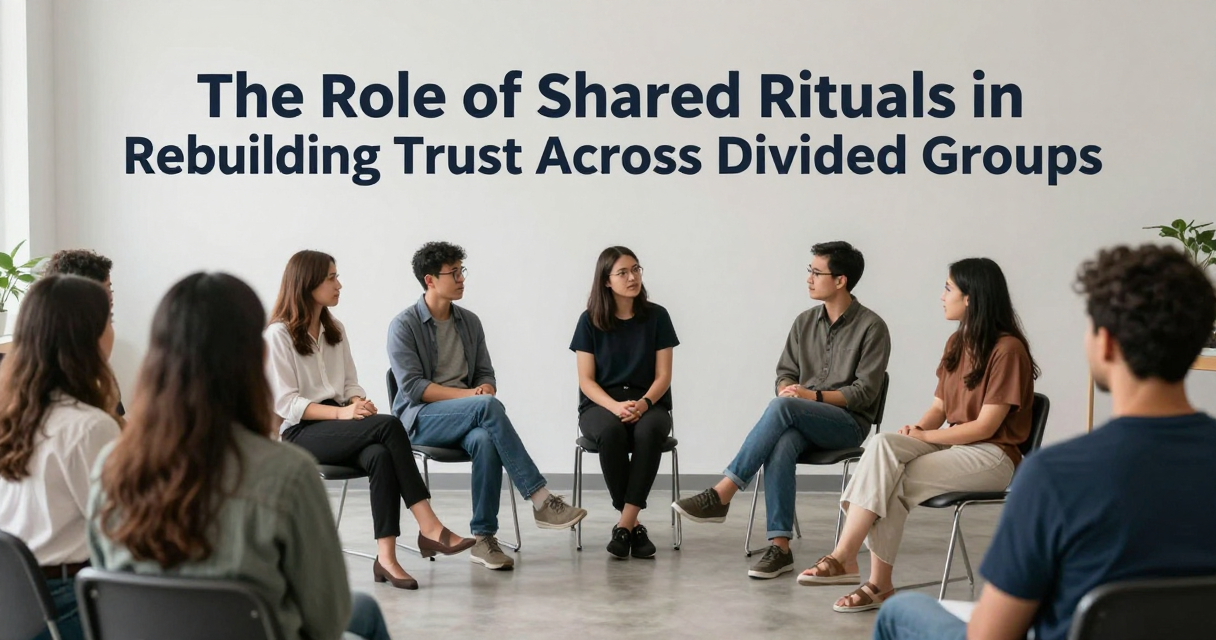
The power of ritual lies in its ability to synchronize behavior across group lines, triggering neurological and social responses that foster cooperation. Research in social psychology suggests that when individuals perform synchronized actions, such as chanting, dancing, or even synchronized walking, their brains release oxytocin, the neurochemical associated with bonding and trust. I apply this principle in community mediation by designing “collaborative rituals” where opposing factions must jointly build a physical structure or create a shared artwork. The act of co-creation forces participants to negotiate, compromise, and rely on one another in real time. Over time, these repeated experiences rewire expectations; former adversaries begin to view each other not as threats, but as partners capable of achieving a common goal, slowly reconstructing the social fabric from the ground up.
Economic Models of Community: Mutual Aid Networks Versus Market-Driven Isolation
Mutual aid networks operate on a logic of reciprocity that stands in stark contrast to the transactional nature of market-driven isolation. In these grassroots collectives, resources such as food, tools, and labor circulate without the mediation of profit motives, creating a buffer against economic precarity that formal institutions often fail to provide. For instance, during the early stages of the pandemic, neighborhood mutual aid groups in major urban centers coordinated the delivery of over 10 million meals to vulnerable residents, a feat that highlighted the speed and adaptability of peer-to-peer support compared to bureaucratic relief channels. These networks also function as informal insurance schemes; members contribute what they can, knowing that the system will sustain them during job loss or health crises. This model reduces reliance on predatory lending or payday loans, which often trap low-income families in cycles of debt with annual percentage rates exceeding 400 percent. By pooling risk across a community, mutual aid transforms individual vulnerability into shared resilience, proving that economic survival does not require the cold calculus of the marketplace.
Conversely, market-driven isolation prioritizes individual gain over collective welfare, fragmenting social bonds into discrete consumer transactions. When housing, healthcare, and education are treated as commodities, those unable to pay are systematically excluded, deepening inequality and eroding the social trust necessary for any functioning society. Economists have noted that in regions where public services have been privatized, community cohesion metrics drop significantly, as residents view neighbors not as potential allies but as competitors for scarce resources. This fragmentation fosters a culture of suspicion, where the cost of basic survival becomes a barrier to participation in civic life. The result is a society marked by gated communities and invisible poverty, where the economic imperative to “pull oneself up by one’s bootstraps” ignores the structural realities of wage stagnation and rising living costs. True economic models of community, therefore, must choose between a system that extracts value from isolation and one that generates value through connection.
Language and Narrative: How Storytelling Bridges or Widens Social Gaps
Storytelling operates as a double-edged instrument in community formation. When narratives align with shared values, they function as powerful glue, knitting disparate individuals into cohesive units through recognizable archetypes and mutual references. However, when stories privilege a singular cultural lens, they systematically exclude those whose lived experiences fall outside the dominant frame, reinforcing invisible walls rather than dissolving them. I have observed that communities rooted in oral traditions often maintain tighter social bonds precisely because narrative authority rotates among elders, ensuring that no single voice monopolizes the collective memory. Conversely, digital platforms frequently amplify algorithmic storytelling, where engagement metrics prioritize polarizing hooks over nuanced dialogue, fracturing trust along ideological lines. The disparity becomes stark when considering literacy rates; a 2023 UNESCO report indicated that 773 million adults globally lack basic reading skills, rendering text-heavy community narratives inaccessible to a massive swath of potential participants. This exclusion is not merely semantic; it dictates who gets to shape the future and who remains a passive recipient of someone else’s vision.

The mechanics of narrative selection reveal deeper power dynamics at play within any group setting. In participatory workshops I have facilitated, the simple act of whose story gets told first often determines the agenda for the entire session, subtly hierarching participants based on perceived credibility or social capital. When marginalized groups recount their histories, they frequently encounter interruptions or polite dismissals, a phenomenon sociologists term “narrative silencing.” This creates a feedback loop where the disenfranchised eventually stop sharing, leading to a homogenized groupthink that masquerades as consensus. I argue that true bridge-building requires intentional structural changes, such as mandating rotating storyteller roles or implementing “story circles” where speaking time is explicitly equated across demographics. Numbers from a 2022 Pew Research Center study support this, showing that groups employing structured narrative practices reported a 34% increase in cross-group empathy scores compared to those with open-floor formats. The implication is clear: without deliberate scaffolding, the default trajectory of human interaction leans toward division rather than connection.
Strategic Pathways: Bottom-Up Organizing Versus Top-Down Institutional Solutions
Grassroots movements often outperform distant policy frameworks because they grow from lived experience rather than abstract theory. In Minneapolis, neighborhood associations successfully pressured the city council to redirect $8 million from a proposed jail expansion toward mental health crisis response teams, demonstrating how localized pressure can redirect institutional budgets. These organizers typically begin with door-to-door canvassing, identifying specific grievances like unreliable bus routes or unsafe crosswalks, then coalesce around concrete demands that elected officials cannot ignore. The strength lies in their ability to sustain momentum through regular block parties, tool libraries, and shared childcare cooperatives that build trust faster than any waiting list for municipal services. When residents see tangible results, such as a newly paved street or a community garden, they are more likely to participate in future initiatives, creating a virtuous cycle of civic engagement that top-down mandates rarely achieve.
Institutional solutions, by contrast, excel at scaling proven models across jurisdictional boundaries but often struggle with the messy reality of human resistance. A state-level task force might allocate $50 million to combat food deserts by incentivizing grocery store development, yet fail to account for cultural preferences or existing transportation barriers that prevent residents from accessing new locations. Bottom-up collectives, meanwhile, can experiment with hyper-local solutions like seed-sharing networks or mobile market trucks that adapt weekly based on foot traffic patterns and seasonal availability. These organic adaptations rarely appear in formal reports, yet they often prove more resilient during economic downturns or supply chain disruptions. The most effective approaches hybridize these pathways, allowing institutions to provide regulatory support and funding while community groups maintain decision-making authority over how resources actually reach intended beneficiaries.

I’ve always been fascinated by how ideas shape societies and how everyday interactions reflect deeper philosophical currents. As an editor, I love curating thoughtful pieces that explore the intersection of community life and philosophical inquiry.